
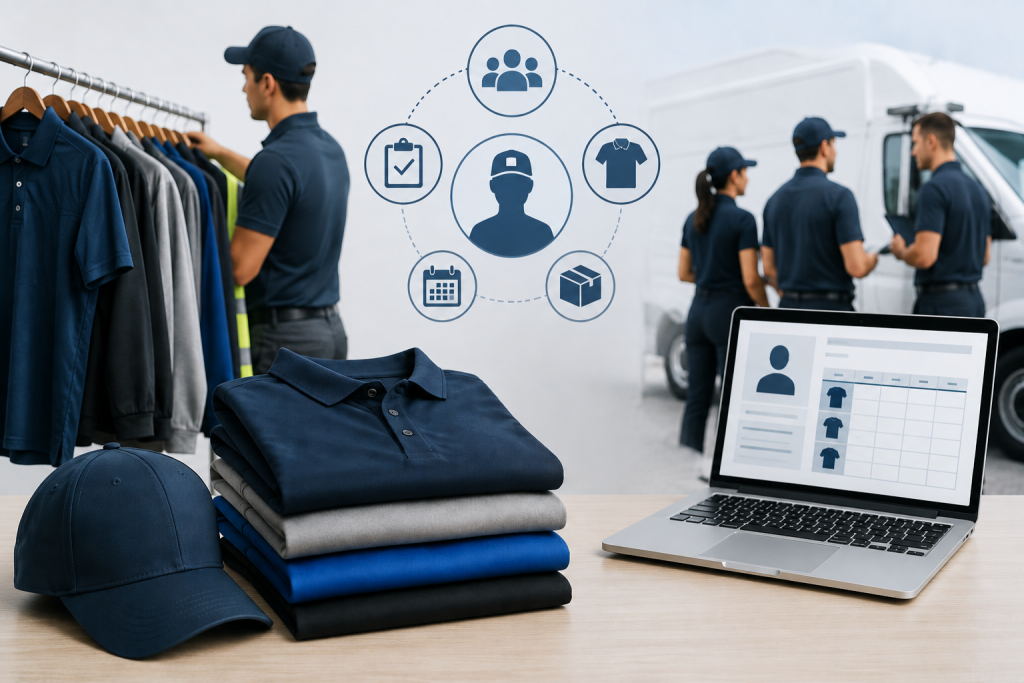
Ordering branded shirts for a small team may be relatively simple, but what happens when you need them for 10, 20, 50, or more employees? Uniform programs that establish standards for what employees wear, how apparel is ordered, and when it should be replaced can make this process much easier and more cost-effective.
If you run a service company—HVAC, plumbing, electrical, pools, pest control, landscaping, or another—here’s how to build a program that can grow with your business.
What Is an Employee Uniform Program?
An employee uniform program is an established system for selecting, ordering, distributing, and replacing company apparel.
Instead of making decisions from scratch every time someone needs a new shirt, your company determines its standards ahead of time. These may include:
- Garment type
- Number of garments per employee
- Approved colors and styles
- Logo location
- Use of employee name
- Distributing to new hires
- Replacement options
Why Does Uniform Management Become More Important as a Service Company Grows?
When you only have a handful of employees, it’s relatively simple to remember everyone’s shirt size or place an occasional order when someone needs a new item. Not so much with a larger staff.
Without clear uniform standards, you may eventually find different crews wearing different shirt colors, older versions of your logo, mismatched garment styles, or worn-out apparel. Managers may also spend more time tracking down sizes or figuring out what a new employee needs.
A uniform program provides a consistent starting point. If you’ve already determined the look and feel of the shirts your technicians wear and what each new hire receives, onboarding becomes much easier.
How Many Uniforms Should Each Employee Receive?
There’s no universal number of uniforms that every employee should have. The right quantity depends on how your team works.
Consider factors such as:
- Employee shifts per week
- Wash frequency
- Indoor or outdoor environments
- Physical job demands
- Garment selection based on work type
- Seasonal apparel
A technician who works outdoors five days a week will likely need more uniform options than an office employee who occasionally sports a branded polo.
How Should You Handle Uniforms for New Employees?
During onboarding, a uniform program should include collecting the employee’s sizes, identifying which garments are required for the position, confirming any personalization, and placing an order using your company’s current specifications.
For example, if every service technician receives five performance shirts, one polo, and one lightweight jacket, you already know garment types and quantities—you just need sizes and names. Keeping a record also simplifies future replacement and reorder requests.
Should Different Employees Have Different Uniforms?
A uniform program doesn’t necessarily mean that everyone has to wear the same clothing, as different positions can have different needs.
Field technicians may benefit from durable, lightweight performance shirts designed for physical work, while supervisors may wear embroidered polos. Sales employees may prefer business-casual polos or button-down shirts, and outdoor crews may require hi-vis or UV-protective apparel. Clothing types can also be used to distinguish these different roles or departments.
The key is consistency. Even if styles differ, the ability to coordinate colors, logo placement, decoration, and overall appearance can keep everyone recognizable within your organization.
Should Employee Names Be Added to Company Uniforms?
For many service companies, displaying employee names on corporate apparel can be a smart decision. Customers may feel more comfortable when they can immediately identify the technician who has arrived at their home or business.
However, personalization comes with a caveat: A shirt embroidered with “Mike” isn’t very useful to the next employee if Mike leaves. Companies with frequent turnover may prefer removable name patches, role identification, or apparel without individual names, whereas those with more stable teams may find personalized embroidery well worth the investment.
The right approach depends on your workforce and customer interactions.
How Can Businesses Maintain Consistent Branding Across Uniform Orders?
One of the easiest ways for company apparel to become inconsistent is through repeat orders that lack established specs: a logo that’s slightly larger on one batch of shirts than the others; a new order that uses a different shade of thread; a shirt color that is close to—but not quite—the original.
Over time, these small differences add up.
A uniform program should establish standards for details such as:
- Approved logo files
- Logo dimensions and placement
- Brand and thread colors
- Approved garment colors
- Preferred apparel styles
- Employee-name placement and formatting
Once established, future orders can follow the same specifications without having to remember what was done the last time.
Embroidery or Screen Printing: Which Works Better for a Uniform Program?
Both decoration methods can benefit a uniform program.
Embroidery is often preferred for polos, button-down shirts, jackets, hats, and other garments for a professional, long-lasting appearance. Screen printing is commonly used for T-shirts, larger graphics, crew apparel, and higher-volume orders.
For comparison, a service company may use embroidered polos for supervisors and screen-printed performance shirts for field crews.
Selecting a method will depend on the garment, design, work environment, quantity, and appearance you’re trying to achieve.
How Often Should Company Uniforms Be Replaced?
Rather than replacing every uniform according to an arbitrary schedule, pay attention to its condition. It may be time for replacement when you notice:
- Significant fading
- Permanent stains
- Tears or damaged seams
- Damaged or distorted logos
- Poor fit
- Outdated branding
- General wear that no longer represents your company well
The work environment matters, too. A construction or landscaping employee’s shirts may naturally experience more wear than apparel used primarily in an office.
Periodic uniform reviews can help managers identify apparel needs so employees look professional.
Seasonal Uniform Considerations for Florida Weather
For businesses here in Jacksonville, the weather certainly plays a role in employee apparel. Heat and humidity make lightweight and moisture-wicking clothing particularly useful for outdoor work, while UV-protective long sleeves can provide additional coverage for crews that spend a lot of time in direct sunlight. When the seasons change, cooler mornings can make lightweight jackets, hoodies, quarter-zips, and rain gear useful additions to a uniform program.
Instead of treating seasonal clothing as an entirely separate purchase each year, companies can establish approved warm- and cool-weather options as part of their overall program. That way, managers already know what to order when temperatures change or employees need another layer.
How Can Growing Companies Make Uniform Reordering Easier?
A good uniform program should make the second, third, and tenth order easier than the first. Maintaining approved garments, artwork, decoration specifications, sizing information, and standard quantities can eliminate many of the decisions involved in reordering.
An online company store can simplify the process even further. Rather than asking employees or managers to search through hundreds of apparel choices every time something is needed, a custom store can feature a predetermined selection of approved products. Depending on how the program is structured, employees or managers can then order from those options without changing the company’s established branding.
This can be especially helpful for businesses with growing teams, multiple departments, or frequent new hires.
What Should You Look for in a Uniform Provider?
As your business grows, it helps to choose a uniform provider that can support your ongoing needs through:
- Consistent embroidery and printing
- Access to durable, name-brand apparel
- Assistance with garment selection and sizing
- Reliable reproduction of logos and brand colors
- Repeat ordering
- Volume-based discounts
- Expedited delivery
- Personalization for individual employees
- Online ordering options
- Responsive customer service
Working with a local provider can offer another advantage. When your apparel partner understands your company, employees, branding, and previous orders, you don’t have to reexplain everything each time you need something.
A Uniform Program That Grows With Your Business
Establishing standards for garments, quantities, branding, personalization, seasonal apparel, replacements, and reordering can turn individual uniform purchases into a repeatable system that supports your team.
If your current approach to company uniforms is becoming difficult to manage, we can help! Logo Xpress works with service companies throughout Jacksonville and Northeast Florida to create custom uniforms and branded workwear through professional embroidery and screen printing.
Contact us today to learn more about creating a uniform program for your team and request a quote.