
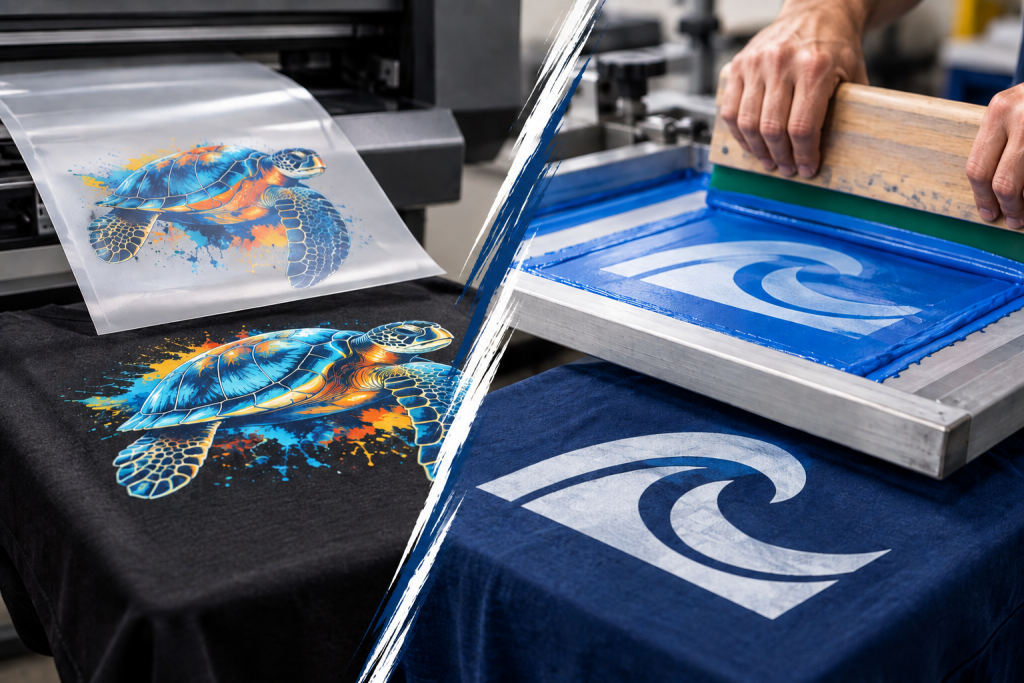
When you want to add your logo or another custom design to T-shirts, uniforms, event apparel, or other garments, part of what you’ll need to decide is how you want it produced. Choosing between DTF printing and screen printing can affect everything from the complexity of your artwork to the number of garments you order.
What Is DTF Printing?
Direct-to-film printing is a digital process that prints a design onto a special film. An adhesive is applied, and the finished design is then transferred from the film onto a garment using heat.
Because the artwork is printed digitally, DTF can reproduce full-color graphics, gradients, fine details, and other elements without needing an individual screen for each color, making it particularly useful for projects with intricate designs, multiple colors, or smaller quantities.
What Is Screen Printing?
Screen printing applies ink directly to a garment through a mesh screen that contains the intended design.
Traditionally, each color in a design requires its own screen, which means more upfront setup—especially as the number of colors increases—but this process also lets you reproduce that same design across many garments efficiently.
Screen printing has long been the preferred method to create custom T-shirts, uniforms, team apparel, and event shirts.
While both methods can produce custom, high-quality apparel, you might choose one over the other for specific reasons. We’ve already touched on the first two, so we’ll keep them brief.
1. The Printing Process
Because DTF starts with a digitally printed image, it can handle elaborate artwork and design changes without needing additional screens. Screen printing requires more initial prep, but once everything is ready, you can easily replicate the same design in bulk.
2. Design Complexity
Does the artwork that you want to display have a straightforward company logo with a few solid colors? Or does it contain gradients, fine details, or more intricate imagery?
3. The Number of Colors
With screen printing, each color generally requires its own screen. A company logo with one or two colors is therefore a far different project from one that needs several. With DTF, multiple colors and gradients can be reproduced as part of a single design.
4. The Number of Garments
Apparel volume will influence which printing method you select. Screen printing is often well suited to bulk orders, while DTF can be practical for smaller batches.
A good example is a company that needs a large number of identical employee shirts versus one that wants a limited number for an upcoming event. Screen printing may make more sense for the first project, while DTF may be worth considering for the second.
5. Garment and Fabric Options
Consider the material you want to decorate. Options like lightweight performance shirts, everyday cotton tees, and employee uniforms can have different characteristics that affect how your design is applied. While DTF and screen printing can both be used on cotton, polyester, and blended garments, it’s worth asking your print vendor how your selected garment and design may affect the finished result using either method.
6. Look and Feel
Because DTF and screen printing apply designs differently, the results of each can have different textures, especially depending on their size and coverage—for example, a large image that takes up most of a shirt’s front compared to a small company logo on the chest.
7. Cost and Overall Project Needs
If you’re wondering whether DTF or screen printing is cheaper, there’s no universal answer. Cost can depend on the factors we’ve already discussed: order quantity, number of colors, artwork complexity, garment selection, sizing, and other production requirements.
Because screen printing requires more upfront setup, that work can have a greater impact on smaller orders. As quantities increase, however, reproducing the same screen-printed design across many garments can become more cost-effective. DTF eliminates much of that traditional setup, making it practical for smaller runs and complex multicolor artwork.
DTF Printing vs. Screen Printing: Which Should You Choose?
Neither printing method is automatically better than the other. The right choice depends on your artwork, garment, quantity, intended use, and budget. When in doubt, a professional printer like Logo Xpress can review what you’re trying to create and recommend an appropriate production method.
Let Logo Xpress Help You Choose the Right Printing Method
Whether you’re ordering custom apparel for employees, an event, a school, a sports team, an organization, or a promotion, the right printing method starts with your project’s needs.
We create custom apparel for customers throughout Jacksonville and Northeast Florida, and we’d be happy to walk you through the intricacies of DTF printing vs. screen printing to determine the best options for your intended garments.
Contact us today to learn more and get a quote!